Cultivating Methods
The following methods are used by oyster farmers to responsibly harvest local sustainable seafood:
Floating bags
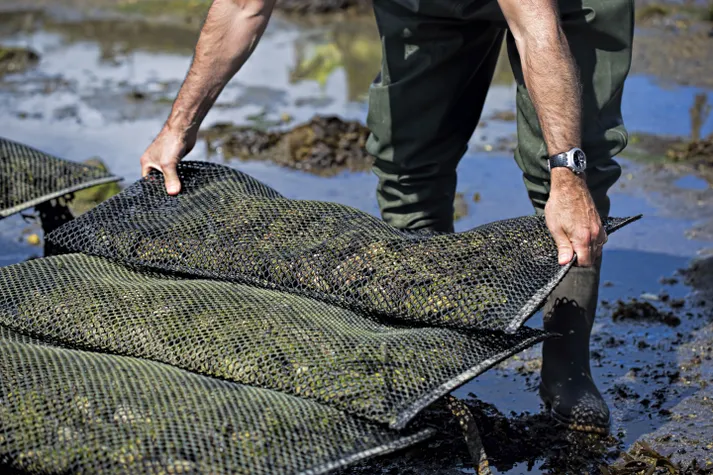
The floating bag system involves growing single seed oysters within mesh bags. The bags remain in the food rich surface waters, supported by closed cell foam or hard plastic floats. Bags are arranged in pairs, one either side of a central longline. To manage biofouling, the bags and oysters can be dried by flipping one of the bags on top of its pair.
FlipFarm
FlipFarm is a semiautomated oyster growing system where baskets are connected centrally to a backbone rope. Each basket has a float attached to one side. The baskets can be turned using a flipper attached to the side of the oyster punt and driving the vessel along the line. This setup is highly adaptable to many growing environments and provides new levels of efficiency to manage biofouling
Oyster Rafts
Oyster rafts are commonly made of timber with attached plastic drums for floatation. Trays are vertically stacked and suspended beneath the raft and are often separated from one another using spacers, to ensure good water flow to the oysters. Suspended tray stacks can consist of 3 to 15 trays depending on the current and water flow.
Intertidal long-line Systems
The intertidal long-line system consists of a single line, on which baskets containing oysters can be attached. The intertidal nature of this system allows oysters to feed for the majority of the tidal cycle, but dry at low tide. This exposure kills biofouling organisms and strengthens the adductor muscle of the oyster, potentially extending its shelf-life after harvest.
Rack and Rail
The rack and rail system involves a container or tray which holds the oysters and is then placed on a supporting rack that is built into the estuary or river. The intertidal nature of this system allows oysters to feed for the majority of the tidal cycle, but dry at low tide. This exposure kills biofouling organisms and strengthens the adductor muscle of the oyster, potentially extending its shelf-life after harvest.